Metro: Last Light Redux — PC action system requirements, expected FPS and crash fixes
2014 · Shooter, Action · Deep Silver · Metacritic 76
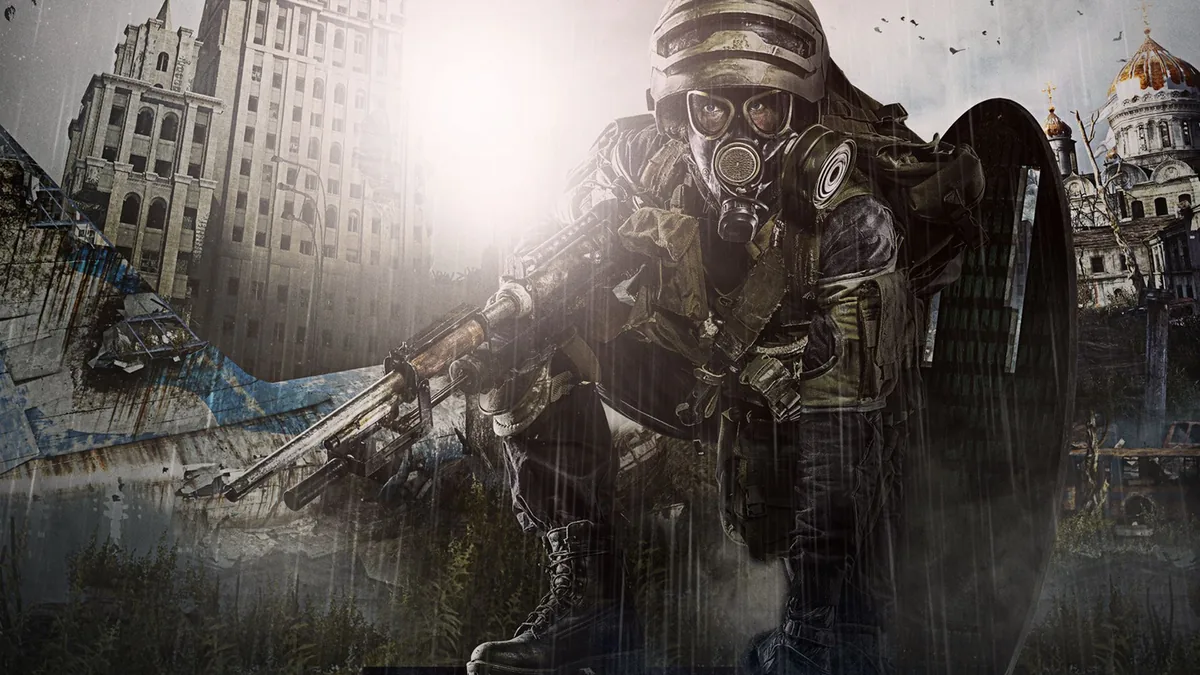
Official system requirements
Publisher-published Minimum / Recommended values via RAWG, retrieved 2026-08-21. Real-world performance varies with drivers, resolution and your full build.
| Spec | Minimum | Recommended |
|---|---|---|
| OS | Minimum: | Recommended: |
| Processor | OS: Windows Vista, 7 or 8 (64-bit only) | OS: Windows 7 or 8 (64-bit only) |
| Memory | Processor: Dual Core CPU (2.2+ GHz Dual Core CPU or better) | Processor: Any Quad Core or 3.0+ GHz Dual Core CPU |
| Graphics | Memory: 2 GB RAM | Memory: 4 GB RAM |
| Storage | Graphics: DirectX 10, Shader Model 4 compliant graphics cards (GeForce 8800 GT 512 MB, GeForce GTS 250, etc) | Graphics: DirectX 11 compliant graphics card (GeForce GTX 480 and above) |
| DirectX | DirectX: Version 10 | DirectX: Version 11 |
| Item 7 | Storage: 10 GB available space | Storage: 10 GB available space |
| Item 8 | Additional Notes: 64-bit only | Additional Notes: (64-bit only) |
Multi-GPU FPS estimate
Estimated average FPS by GPU at 1080p / 1440p / 4K, derived from Metro: Last Light Redux's demand tier (tier 4, Moderate (mainstream GPU)) and published TechPowerUp-style relative-performance indices (RTX 4090 = 100), retrieved 2026-08-29. Planning estimates, not benchmarks.
| GPU | 1080p | 1440p | 4K |
|---|---|---|---|
| RTX 4090 | 202 | 133 | 77 |
| RTX 4080 Super | 181 | 119 | 69 |
| RTX 4080 | 174 | 115 | 66 |
| RX 7900 XTX | 193 | 128 | 73 |
| RX 7900 XT | 181 | 119 | 69 |
| RTX 4070 Ti Super | 154 | 102 | 59 |
| RX 7800 XT | 154 | 102 | 59 |
| RTX 4070 Super | 145 | 96 | 55 |
| RTX 4070 | 136 | 90 | 52 |
| RX 7700 XT | 140 | 92 | 53 |
| RTX 3070 | 127 | 84 | 48 |
| RX 6800 XT | 153 | 101 | 58 |
| RTX 4060 Ti | 112 | 74 | 43 |
| RX 6700 XT | 136 | 90 | 52 |
| RTX 3060 | 102 | 68 | 39 |
| RX 6600 XT | 116 | 76 | 44 |
| RTX 2060 | 93 | 61 | 35 |
| GTX 1660 Super | 77 | 51 | 29 |
| RX 580 | 89 | 59 | 34 |
| GTX 1060 6GB | 73 | 48 | 28 |
| GTX 1650 | 58 | 38 | 22 |
| Intel Arc A770 | 118 | 78 | 45 |
| UHD 770 (integrated) | 24 | 16 | 9 |
Method: a game's demand tier maps to a “GPU index needed for ~60 FPS at 1080p”; each GPU's relative index produces an estimate via a diminishing-returns curve, then scaled for resolution. Source: TechPowerUp GPU database (relative performance), 2026-08-29.
For the full hardware spec sheet and a deeper performance breakdown, see Full specs & performance data on GameFigs.
Age rating & regional compliance
GameRulePro pairs each title with its ESRB age rating and, where documented, real regulatory notes on loot boxes, skin gambling and randomized monetization. Every line is source-linked and labeled with its retrieval date. This is an educational reference, not legal advice — verify the specifics that apply to your jurisdiction.
| Field | Value | Source |
|---|---|---|
| Age rating | Not indexed on GameRulePro | ESRB |
Similar games you may tune or rule next
Left 4 Dead 2
2009 · Shooter, Action
Open profile →Half-Life 2
2004 · Shooter, Action
Open profile →BioShock Infinite
2013 · Shooter, Action
Open profile →Borderlands 2
2012 · Shooter, Action
Open profile →BioShock
2007 · Shooter, Action
Open profile →Destiny 2
2017 · Shooter, Action
Open profile →PAYDAY 2
2013 · Shooter, Action
Open profile →DOOM (2016)
2016 · Shooter, Action
Open profile →Best graphics settings for Metro: Last Light Redux
Pick your PC and get a starting preset — resolution, upscaler, shadows, ray tracing and an FPS cap — tuned to how demanding Metro: Last Light Redux is on hardware. Print it and tune from there. Everything runs in your browser.
Best graphics settings for Metro: Last Light Redux
Metro: Last Light Redux hardware-demand tier: 4/9. Pick your PC above to get a starting preset, then tune up if you have FPS headroom or down if you're under your target.
Estimated starting point — real FPS depends on drivers, thermals and background load.
Metro: Last Light Redux — Best settings (Mid-range (GTX 1660 – RTX 3060))
Generated at GameRulePro · 2026-09-25
Release, patch & rule-change notes
Official release date: 2014-08-25. Ongoing patches and version history are published by the developer — for the latest patch notes, see the official store or support page. GameRulePro summarizes the official release only and does not invent patch dates. When a developer ships a rule-affecting update (balance pass, mode change, or ranked-reset), re-run the generator above to keep your house rules in sync.
About Metro: Last Light Redux
It is the sequel to the game Metro 2033. Both games are based on the world of Dmitry Glukhovsky's novel Metro 2033 - in post-apocalyptic Moscow, in the tunnels of subway lines groups of very different people survive. And not only people. There are mutated people there, and mutated animals. They are distinguished by unusual abilities, but even more - behaviour strategies. In the struggle for the remnants of resources, all these beings spend their gloomy days. All characters use unusual and unexpected means for life and war. Something is created from the remnants of a past, normal life, something has already appeared in a new, changed world. Locations are struck by an unusual synthesis of the ruins of a known world and traces of a catastrophe. From the previous game Metro: Last Light differs, according to general opinion, by careful work on the remarks and shortcomings of the previous game. The set of weapons is significantly expanded, the technologies of Metro 2033 have become more developed. The game has two fundamentally different endings and five additions.
Performance reality & how to tune Metro: Last Light Redux
GameRulePro editorial — these notes are based on Metro: Last Light Redux's published specifications and genre profile, not a single benchmark run. Use them to set expectations before you open the settings menu.
As a 2014 fast-paced shooter title, Metro: Last Light Redux sits at demand tier 4 (Moderate (mainstream GPU)) — moderately demanding on PC. Most discrete GPUs from the last few generations run it fine at 1080p with headroom to spare.
What to tune first on Metro: Last Light Redux
- Drop shadows, ambient occlusion and volumetric fog first — they cost the most FPS for the least visual change.
- Disable ray tracing unless you have a high-end GPU; it rarely changes competitive feel.
- Cap the frame rate to your monitor refresh to keep input lag consistent.
The FPS table above is a model estimate from the demand-tier + GPU-index method. Real frame rates vary with drivers, background apps, thermals and resolution. Treat it as a buying or upgrade planning aid, then verify in-game. For step-by-step fixes, see the crash-fix and optimization guides linked on this page.
Sources & attribution
- Game data (release year, genres, platforms, system requirements, description, cover art) via RAWG.io, retrieved 2026-08-21.
- GPU relative-performance indices via TechPowerUp GPU database (relative performance), retrieved 2026-08-29.
- FPS estimates on this page are GameRulePro planning estimates from the demand-tier + GPU-index model — not benchmark results.
- House rules and tournament formats are community-style templates for casual play, not official rulebooks.
- Pre-launch intelligence (release windows, settings, editions, pricing, beta dates) is compiled from each title's official publisher / studio announcements and is source-linked per item with its retrieval date (2026-09-09). Where a detail is from reporting rather than a primary source, the item's source line states so. This is preview material, not an official specification.
- Per-game age-rating & regional compliance reference (ESRB rating via RAWG; curated regulatory notes) from the GameRulePro game-rules dataset, retrieved 2026-08-29.
How the Metro: Last Light Redux FPS estimate and rules generator are computed
Each game is scored on a 0–9 demand tier from its published PC requirements (and a year/genre fallback when requirements are absent). The FPS estimate compares your selected GPU's relative-performance index against the tier's required index using a diminishing-returns curve, then scales for resolution. The rules and tournament builder is a community-style template engine: it formats your group size, match format and tiebreaks into a printable sheet. All outputs are planning guides — verify in-game and agree house rules with your group before play.
Do more with Metro: Last Light Redux
Can I run it? FPS calculator
Estimate frame rates at 1080p, 1440p and 4K for your exact GPU.
Open →Step 2Crash fixes & FPS optimization
Every fix and optimization guide for this and every other title.
Open →Browse all 335 games
Compare requirements and projected FPS across the whole database.
Open →2026-2027 release calendar
Launch dates and platforms for upcoming titles.
Open →